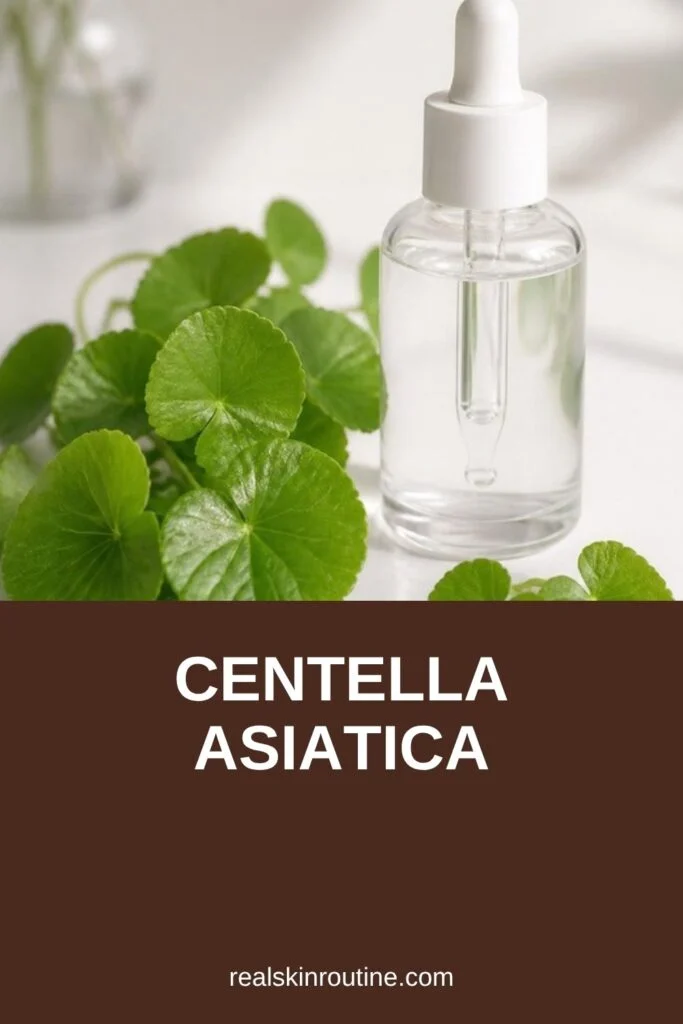
Quick answer: Centella asiatica is a plant extract, often labeled “cica,” that shows up in gentle serums, toners and creams. Brands use it in formulas meant to feel calming and comfortable. It isn’t a medicine, so think of it as a gentle cosmetic ingredient, and patch test it first as the AAD suggests for any new product (AAD).
Table of Contents
What is centella asiatica?
Centella asiatica is a small leafy plant. In skincare it appears as an extract or as isolated compounds such as madecassoside and asiaticoside. You’ll often see it called cica, tiger grass or gotu kola on packaging.
Many Korean beauty brands made centella asiatica popular in soothing-feel creams and toners. Today it shows up in all kinds of formulas, from light gels to rich balms.
Why people like centella asiatica
- It’s usually in gentle formulas. Brands often pair it with fragrance-free, simple bases.
- It layers easily. A cica serum or toner fits between cleanser and moisturizer.
- It comes in many textures. Gels, essences, creams and sheet masks.
- It pairs with basics. Many formulas combine it with glycerin, panthenol or ceramides.
- It suits a calm, simple routine. Good for anyone who wants fewer, gentler steps.
The feel is the main draw. Results vary between people and products, so choose based on how your skin looks and feels after a few weeks.
How to use centella asiatica in your routine
- Cleanse gently. The AAD suggests lukewarm water and a mild, non-abrasive cleanser applied with your fingertips (AAD).
- Apply a centella toner or serum to slightly damp skin.
- Follow with moisturizer, or use a cica cream as your moisturizer.
- Finish with sunscreen in the morning.
- Use it once or twice a day, depending on the product directions.
Our morning skincare routine and night skincare routine show where a serum or cream fits.
Centella asiatica product types compared
| Product | Texture | Good for |
|---|---|---|
| Toner or essence | Watery | Light layering, oily skin |
| Serum | Light gel | Targeted step before cream |
| Cream | Rich | Dry or normal skin, night |
| Sheet mask | Soaked sheet | Occasional pampering |
We haven’t lab-tested these options. The table compares them by what the label says and how they’re usually made.
What to check on the label
- Where centella sits in the list. Higher up usually means more of it.
- Fragrance. Many people prefer fragrance-free when choosing gentle products.
- The other ingredients. A simple formula makes it easier to tell how your skin responds.
- Claims. Skip products that make big promises about skin conditions; cosmetics are about look and feel.
- Your skin type. Gels suit oily skin, creams suit dry skin.
Patch test anything new. The AAD suggests applying a new product to a quarter-sized spot on the underside of your arm or the bend of your elbow twice a day for 7 to 10 days, and stopping if your skin reacts (AAD).
If you’re new to it, start with one product rather than a full line. A single serum or cream is enough to see whether you like the texture and how your skin looks after a few weeks. Keep the rest of your routine the same so any change is easy to spot.
Store skincare away from heat and direct sunlight, close lids tightly, and note the date you opened each product. Toss anything that smells odd or changes color. Simple habits like these keep any routine pleasant to use.
Common centella asiatica mistakes
- Adding several new products at once. Introduce one at a time.
- Expecting instant results. Give a new product a few weeks.
- Skipping sunscreen. Daily SPF still matters in the morning.
- Assuming plant means gentle for everyone. Anyone can react to any ingredient.
- Using it instead of seeing a doctor. For ongoing redness or irritation, see a board-certified dermatologist.
For the full order of cleanser, serum, moisturizer and sunscreen, see our skin care routine.
Related guides: Micellar Water: How to Use It the Right Way.
FAQ
What does centella asiatica do for skin?
It’s a plant extract used in gentle, comfortable-feeling skincare. It’s a cosmetic ingredient, not a medicine.
Is cica the same as centella asiatica?
Yes. Cica is a nickname for centella asiatica, and you may also see tiger grass or gotu kola.
Can I use centella asiatica every day?
Many people do, once or twice a day. Follow the product directions and patch test first.
Can I use centella with retinol or vitamin C?
Many people layer them. Add one new product at a time so you can tell how your skin responds.
Is centella asiatica good for sensitive skin?
It often appears in gentle formulas, but anyone can react. Patch test before using it on your face.
Written by Mahmoud Abdelmaksoud.