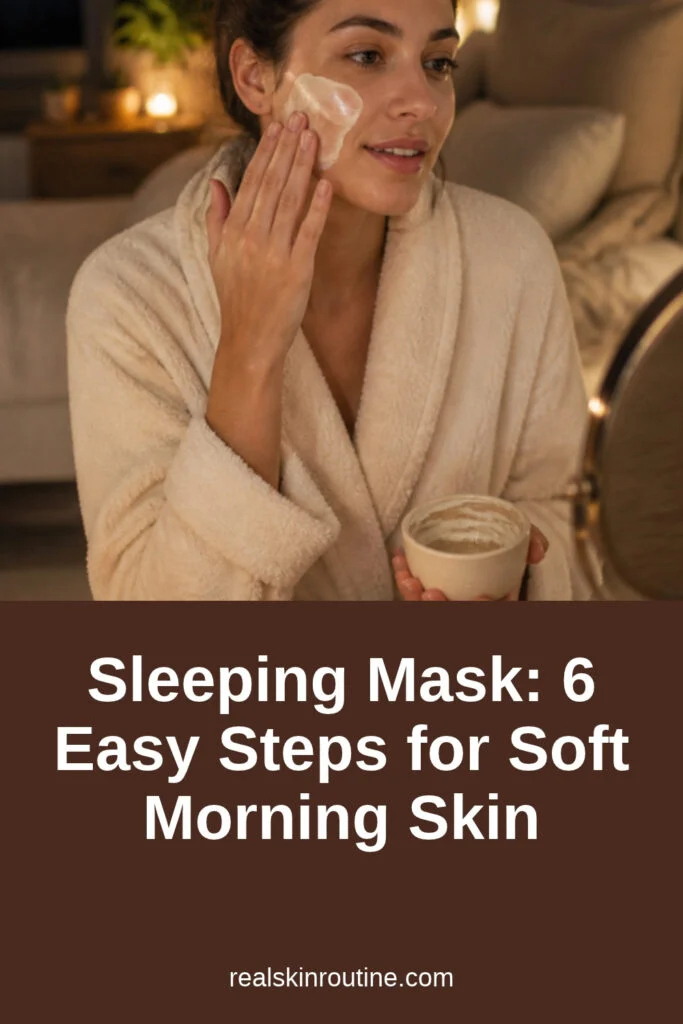
Quick answer: A sleeping mask is a rich leave-on mask you apply as the last step of your night routine and rinse off in the morning. Use a thin layer over clean skin and moisturizer a few nights a week. It helps skin feel soft and smooth when you wake up.
Table of Contents

Sleeping mask types
| Type | Texture | Best for |
|---|---|---|
| Gel | Light and cool | Oily or combination skin |
| Cream | Rich and thick | Dry skin |
| Jelly | Bouncy and light | Normal skin |
| Balm | Very rich | Very dry areas |
Gel and jelly types feel lightest on the skin.
Who a sleeping mask suits
A sleeping mask suits most skin types when you choose the right texture. Dry skin often likes a cream, while oily skin may prefer a gel. If your skin is sensitive, choose a simple, fragrance-free formula. Fragrance can bother some skin, as the FDA notes (FDA).
How to use a sleeping mask in 6 steps
- Cleanse. Wash your face gently and pat it dry.
- Apply toner or serum. Use your usual toner or face serum.
- Moisturize. A light moisturizer goes on first.
- Apply the mask. Smooth a thin layer over your face.
- Let it set. Wait a few minutes before lying down.
- Rinse in the morning. Wash it off with lukewarm water.
The AAD advises washing your face with lukewarm water and your fingertips, then gently patting it dry with a soft towel (AAD).
Tips for better results
- Use a thin layer. More product does not mean better results.
- Skip the eye area. Use an eye cream there instead.
- Use a clean pillowcase. Change it often.
- Start slowly. Try it a couple of nights a week first.
- Patch test first. Try it on a small area.
The AAD suggests testing a new product on a small area of skin twice a day for several days and stopping if a reaction appears (AAD).
How often to use it
A few nights a week is a good start for most people. If your skin feels dry in winter, you can use it more often. On other nights, keep to your usual night skincare routine. Watch how your skin feels and adjust from there.
Choosing a texture
Think about how your skin feels in the evening. If it often feels tight or flaky, a rich cream will feel comforting. If it gets shiny by the afternoon, a light gel or jelly may feel better. In winter you might switch to a richer type, then go back to a lighter one in warm months. Read the label for how often the brand suggests using it.
Common mistakes
- Applying it on dirty skin. Always cleanse first.
- Using a thick layer. It can transfer to your pillow.
- Skipping the rinse. Wash it off in the morning.
- Using it every night at once. Build up slowly.
- Mixing too many actives. Keep the routine simple.
Small changes help a sleeping mask work better for you.
For dry skin, see our skincare routine for dry skin. A sleeping mask is a simple way to finish your night routine.
FAQ
Do I rinse a sleeping mask off?
Yes, rinse it off in the morning.
Can I use it every night?
Some people do; start with a few nights a week.
Does it replace moisturizer?
Usually not; apply it over moisturizer.
Is it good for oily skin?
Yes, choose a light gel type.
Can I use it around my eyes?
Use an eye cream there instead.
Will it stain my pillow?
A thin layer that sets first rarely does.
Related guide: Peel Off Mask: How to Use One Gently.
Written by Mahmoud Abdelmaksoud.