


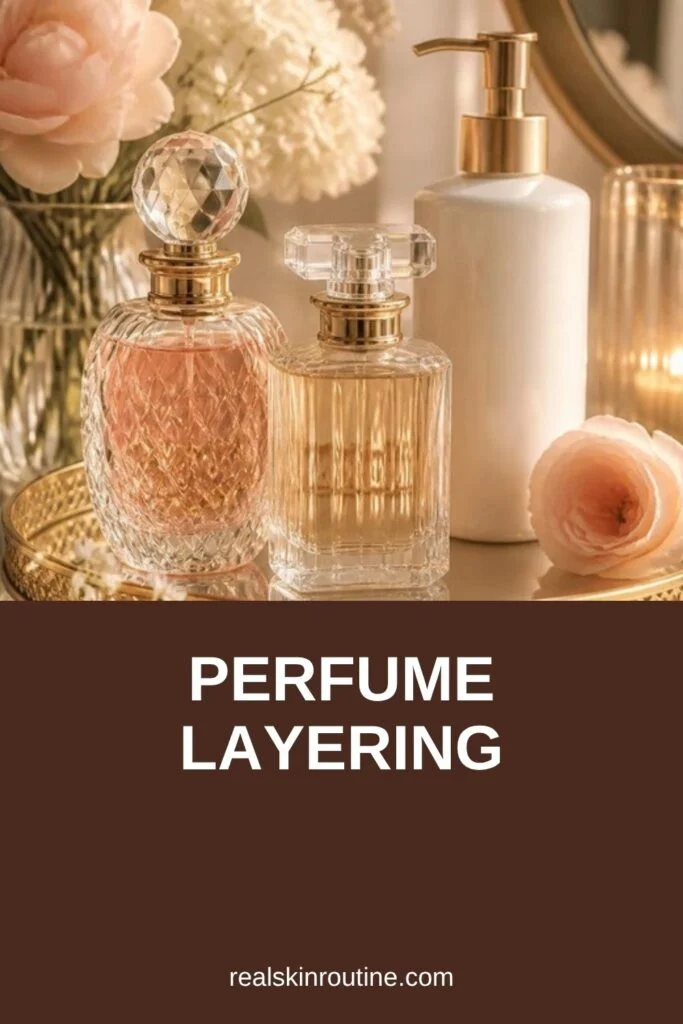
Quick answer: Perfume layering means wearing two or more scents together to create one you like better. Start with a moisturized base, apply the heavier scent first and the lighter one on top, and keep it to two or three layers. The FDA notes that fragrance can be listed simply as “fragrance” on labels and that some people react to fragrance ingredients, so test combinations on a small area first (FDA).
Table of Contents

How perfume layering works
Every perfume has top notes you smell first, heart notes that show up after a few minutes, and base notes that last longest. Perfume layering blends those notes across two scents so the mix feels personal.
You can layer perfumes with each other, or build from scented body products such as a body wash, lotion or oil. Unscented lotion is the simplest base.
Scent families that pair well
| Base scent | Pairs well with | Result |
|---|---|---|
| Vanilla or amber | Citrus or florals | Warm and bright |
| Woody | Fresh citrus or green notes | Clean and grounded |
| Musk | Almost anything light | Soft, skin-like |
| Floral | Fruity or vanilla | Sweet and romantic |
| Citrus | Woods or musk | Fresh with more staying power |
A simple rule for perfume layering: pair one richer scent with one lighter scent, and avoid stacking two very strong ones.
Perfume layering: 7 steps
- Shower with a gentle or matching body wash.
- Moisturize. Scent tends to last longer on moisturized skin.
- Apply the heavier perfume first. Woods, amber and vanilla go on the bottom.
- Add the lighter scent on top. Citrus, florals and fresh notes sit best here.
- Spray pulse points lightly, such as wrists, neck and inner elbows.
- Don’t rub your wrists together. Let the perfume dry on its own.
- Wait 15 to 30 minutes before judging the blend.
Tips for better perfume layering
- Start with two scents. Three is plenty for most blends.
- Test on paper first. Spray two strips and hold them together.
- Keep a note of blends you like. It makes them easy to repeat.
- Go lighter in warm weather. Heat makes scent feel stronger.
- Spray on clothes with care. Some perfumes can mark fabric.
Our body care routine and shower routine show how scent fits after cleansing and moisturizing, and body oil for dry skin can double as a scent-holding base.
Fragrance and sensitive skin
The FDA says fragrance ingredients may appear only as “fragrance” on a label, that even “unscented” products can contain masking scents, and that people who react to fragrance may prefer fragrance-free products (FDA).
If your skin is sensitive, spray perfume on clothing or hair ends instead of skin, and keep fragrance off irritated areas. Patch test anything new. The AAD suggests applying a new product to a quarter-sized spot on the underside of your arm or the bend of your elbow twice a day for 7 to 10 days, and stopping if your skin reacts (AAD).
Perfume layering is also a nice way to use up bottles you rarely wear. A fresh citrus you find too fleeting can gain staying power over a soft musk, and a sweet vanilla can feel lighter with a splash of green notes on top. Try new pairs on a quiet weekend, give each blend a full day, and keep the ones you reach for again. Store bottles in a cool, dark place, away from bathroom steam and sunny windowsills, so the scents stay true for longer.
Keep notes on your favorite pairs so you can repeat them easily.
Common perfume layering mistakes
- Layering too many scents. The blend turns muddy.
- Pairing two heavy perfumes. It can feel overwhelming.
- Rubbing wrists together. It dulls the top notes.
- Judging too early. Wait for the heart notes.
- Over-spraying. One or two sprays of each is enough.
Related guides: Body Butter for Dry Skin: How to Choose One, Body Gua Sha: How to Use a Body Scraping Tool.
FAQ
What is perfume layering?
Wearing two or more scents together, or pairing a scented body product with perfume, to create a blend you like.
Which perfume goes on first when layering?
The heavier one, such as woods, amber or vanilla. Lighter citrus or floral scents go on top.
How do I make perfume last longer?
Apply to moisturized skin, spray pulse points and don’t rub your wrists together.
How many perfumes can I layer?
Two is a good start. Three is plenty for most blends.
Can perfume bother sensitive skin?
Some people react to fragrance ingredients. Spray on clothing instead, or choose fragrance-free products.
Written by Mahmoud Abdelmaksoud.

1 comment