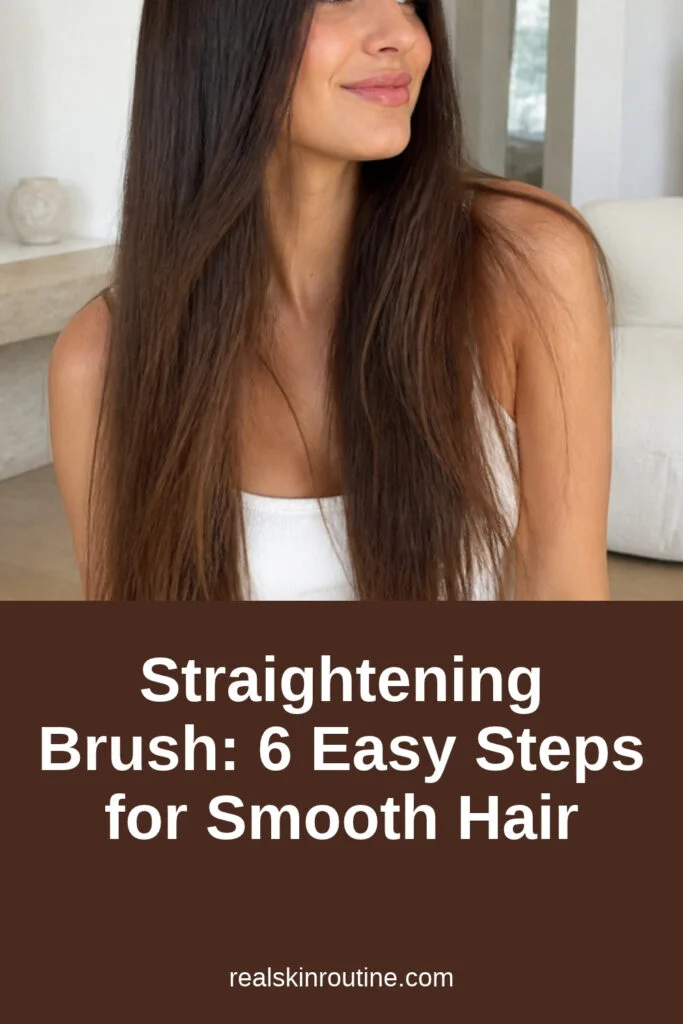
Quick answer: A straightening brush is a heated brush that smooths hair as you brush it. Start with fully dry, detangled hair and a heat protectant, take small sections and brush slowly from the roots to the ends. It gives a softer, more natural result than a flat iron, with more volume.
Table of Contents

Straightening brush vs flat iron
| Feature | Brush | Flat iron |
|---|---|---|
| Finish | Smooth with volume | Very sleek |
| Speed | Fast | Slower |
| Ease | Very easy | Needs practice |
| Best for | Everyday smoothing | Poker-straight looks |
A brush is easier for beginners.
Who a straightening brush suits
It suits wavy and frizzy hair that wants a smooth, natural finish. Fine hair keeps more volume than with a flat iron. Very curly or coily hair may need more passes and smaller sections. It is quick, so it suits busy mornings. For bends and curls with a flat iron instead, see our flat iron curls guide.
How to use a straightening brush in 6 steps
- Start with dry hair. Never use it on wet hair.
- Detangle. Use a detangling brush.
- Protect. Mist a heat protectant spray.
- Choose a low setting. Start low and raise only if needed.
- Brush slowly. Work small sections from root to end.
- Let it cool. Then finish with a drop of serum.
Slow, steady strokes work better than many fast ones.
Tips for smooth results
- Use small sections. Heat reaches all the hair.
- Keep tension light. Do not pull hard.
- Brush under for volume. Lift at the roots.
- Clean the bristles. Remove hair and product.
- Unplug after use. Let it cool on a heat-safe surface.
The AAD advises turning down the heat on hot styling tools and using them less often, because heat can damage hair (AAD).
Common mistakes
- Using it on damp hair. It can damage hair.
- Highest heat by default. Use the lowest that works.
- Big sections. Results are uneven.
- Skipping protectant. Hair is less protected.
- Holding it near the scalp too long. Keep it moving.
Keep the hot bristles away from your scalp, ears and neck.
How to choose a straightening brush
Look for a straightening brush with adjustable heat, so you can use a lower setting on fine hair. A wider straightening brush covers more hair and works well on long or thick hair. Heat-resistant tips on the bristles help protect your scalp. An auto shut-off feature is handy if you style in a rush. Some types have an ionic setting that may help reduce frizz. Choose a size that feels light and easy to hold in your hand.
Straightening brush care
Unplug the straightening brush and let it cool fully before you remove hair from the bristles or wipe the plates.
Finishing touches
Smooth flyaways with a tiny drop of silicone-free hair oil. For a sleek look, follow with a boar bristle brush. Keep the style overnight with a silk pillowcase.
For daily care, see our hair care routine. It is a quick way to smooth hair while keeping natural movement.
FAQ
Is it better than a flat iron?
It is easier and gives more volume, but less sleek.
Can I use it on wet hair?
No.
Which heat setting should I use?
Start with the lowest that works.
Does it work on curly hair?
Yes, with small sections.
How long does it take?
Often less time than a flat iron.
Do I need heat protectant?
Yes.
Related guide: Round Brush: How to Get a Smooth, Bouncy Blowout.
Written by Mahmoud Abdelmaksoud.